Showing posts with label What is it Wednesday. Show all posts

Wednesday, March 2, 2022

What is it Wednesday: March 2, 2022


Can you identify what's in this photo?


Each Wednesday morning 

on Camp Lutherlyn's Facebook page

 the Lutherlyn Environmental Education Program posts a photo. 


Readers have all morning and afternoon 

to make their best guess about what the photo is. 


Around 6 pm LEEP provides the answer and a brief explanation.


Each week's What is it Wednesday post 

will also be posted on the Nature of Lutherlyn blog, 

 after it is posted on Facebook,

sometimes with additional bonus information. 


In addition to bringing you current editions of What is it Wednesday 

on the Nature of Lutherlyn blog, 

we will be reposting old editions,

creating a What is it Wednesday archive. 


This photo was posted as a What is it Wednesday on

March 2, 2022. 


And the answer is....


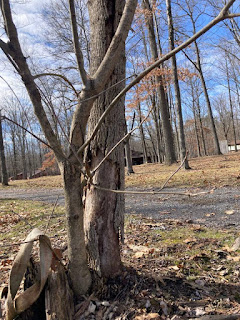
This little cluster of trees are young ash trees,
all growing from the stump of an ash tree that died several years ago.

Ash branches are distinctive because they are one of the few types of trees in our area to have opposite branching pattern – the twigs look like arms growing directly across from each other on the branch. Maples also have opposite branching pattern, but ash twigs are thicker and lighter in color than maples, especially our red maples.

ash twigs with opposite branching pattern

Ash trees are champion stump-sprouters. After an ash tree has died or been cut down, new shoots will grow up out of the stump that was left behind. 


Almost all of our mature ash trees at Lutherlyn (and in much of western Pennsylvania) have died.This is because of the emerald ash borer, an invasive beetle that lays eggs inside the bark of ash trees. When those eggs hatch, the larvae digging their way out of the tree kills the tree. 

But, ash trees are not gone from Lutherlyn, because so many of the ash stumps sprouted new growth. By the time these trees get bigger, the emerald ash borer population may be low enough that not all of the trees in an area will be killed by them in the next generation.  New life emerges out of the death that went before.

For more on emerald ash borers, check out this blog post from back in 2013: https://lutherlynnature.blogspot.com/2013/02/ashes-to-ashes.html

Like and follow Camp Lutherlyn on Facebook, to see What is it Wednesday posts when they come out and have the opportunity to share your guesses in the comments!


Wednesday, February 23, 2022

What is it Wednesday: February 23, 2022


Can you identify what's in this photo?


Each Wednesday morning 

on Camp Lutherlyn's Facebook page

 the Lutherlyn Environmental Education Program posts a photo. 


Readers have all morning and afternoon 

to make their best guess about what the photo is. 


Around 6 pm LEEP provides the answer and a brief explanation.


Each week's What is it Wednesday post 

will also be posted on the Nature of Lutherlyn blog, 

 after it is posted on Facebook,

sometimes with additional bonus information. 


In addition to bringing you current editions of What is it Wednesday 

on the Nature of Lutherlyn blog, 

we will be reposting old editions,

creating a What is it Wednesday archive. 


This photo was posted as a What is it Wednesday on

February 23, 2022. 


And the answer is....


This is a firefly of the genus Ellychnia.
Ellychnia fireflies do not light up,
and are one of the first insects to become active in late winter,
so they are sometimes known as dark fireflies or winter fireflies.

While fireflies are known for their flashing light displays during summer nights, Ellychnia fireflies are lanternless (they don’t have a light) and diurnal (they are active during the day), and the adults are not active during the summer but when they emerge in September and again from late February to late May. 

The usual firefly life cycle goes like this: adults mate in summer (that’s what the flashing is all about – attracting a mate). Females lay eggs, which hatch later in the summer. Larva overwinter under leaf litter or just below the surface of the soil. The larva pupate and metamorphose into adults early the following summer, and the cycle begins again as those adults look for mates.

The life cycle of dark fireflies is a little different. Adults which emerge in late summer overwinter in the bark of trees. They begin to be active again starting in late February when temperatures warm up. The adults mate in early spring (April-May), attracting mates using pheromones instead of flashing lights, and eggs hatch by summer. The larva remain in that stage for about 16 months. The eggs, larva and pupa do have fireflies’ characteristic bioluminescence, although the adults do not! 


At the end of their second summer, the larva become pupa, then adults emerge in September. These adults will gather on the trunks of trees, wedge themselves into grooves in the bark, and overwinter there. About 90% of the adults survive the freezing temperatures of winter like this! When the weather begins to warm up in late winter, adults resume activity, and we see them hanging around our maple buckets.

Spotting dark fireflies during maple sugaring is a sure sign that spring is on the way, and a hint of the promise of the summer evenings to come with their enchanting cousins. What seasonal indicators do you like to watch out for this time of year? 

For more on winter fireflies from renowned firefly scientist Dr. Sara Lewis, see https://silentsparks.com/2019/06/01/the-winter-firefly/.

This is also a nice reflection on fireflies in general and the lanternless variety in particular:  https://www.adirondackalmanack.com/2019/03/fireflies-of-winter.html


Like and follow Camp Lutherlyn on Facebook, to see What is it Wednesday posts when they come out and have the opportunity to share your guesses in the comments!

Wednesday, February 16, 2022

What is it Wednesday: February 16, 2022


Can you identify what's in this photo?


Each Wednesday morning 

on Camp Lutherlyn's Facebook page

 the Lutherlyn Environmental Education Program posts a photo. 


Readers have all morning and afternoon 

to make their best guess about what the photo is. 


Around 6 pm LEEP provides the answer and a brief explanation.


Each week's What is it Wednesday post 

will also be posted on the Nature of Lutherlyn blog, 

 after it is posted on Facebook,

sometimes with additional bonus information. 


In addition to bringing you current editions of What is it Wednesday 

on the Nature of Lutherlyn blog, 

we will be reposting old editions,

creating a What is it Wednesday archive. 


This photo was posted as a What is it Wednesday on

February 16, 2022.


And the answer is....


This leaf is not only red-colored, it is the leaf of a red maple tree. 


We have red maples on our minds, because it is maple sugaring season and at Lutherlyn the trees we tap for making maple syrup here are all red maples. Sugar maples have the most sugar in their sap, as the name implies, but red maples also have enough sugar in the sap to effectively make syrup. 

You can tell the difference between red maple leaves and sugar maple leaves by paying attention to some details. Red maple leaves generally have three main lobes - sugar maple leaves have five main lobes (picture the Canadian flag). The space between the lobes (known as the sinus) is v-shaped in red maples, and in sugar maples is more u-shaped. And the most reliable difference is that red maple leaves have serrated edges, while sugar maple leaves are smooth-edged between points.


Leaf shapes, however, are rather variable! You can sometimes find sugar maple leaves that have sinuses that are closer to v-shaped; and red maple leaves that have small points on the bottom of the leaf on each side – does that count as three or five lobes? And of course – leaves are not present on the trees year-round! So looking at the leaves is not always the best way to distinguish the type of tree.

The answer is in the name: Red! The leaves of red maples turn a bright red in the fall (as in this photo) but also the leaf stems, ends of the twigs, and the buds of red maples are all distinctly red. The twigs and buds of sugar maples are brown. Red maples are the most abundant and most widespread tree species in North America. They can grow in a wide variety of habitats, even in areas that are too wet for other trees to thrive, including sugar maples.

At our maple sugaring Saturday Safaris, participants learn other tricks for winter tree id as well – you need to know how to pick out a maple tree (whether it's sugar or red) from all the other trees in a forest so you know which ones to tap! We also include tapping trees, collecting sap, watching the process of making sap into syrup, and of course tasting syrup! The maple sugaring Saturday Safari is always the first Saturday in Marchbut maple sugaring experiences at Lutherlyn are available for school field trips and scout groups too. Check out www.Lutherlyn.com/ee  for info on these and other LEEP events!  

Like and follow Camp Lutherlyn on Facebook, to see What is it Wednesday posts when they come out and have the opportunity to share your guesses in the comments!

Wednesday, February 9, 2022

What is it Wednesday: February 9, 2022


Can you identify what's in this photo?


Each Wednesday morning 

on Camp Lutherlyn's Facebook page

 the Lutherlyn Environmental Education Program posts a photo. 


Readers have all morning and afternoon 

to make their best guess about what the photo is. 


Around 6 pm LEEP provides the answer and a brief explanation.


Each week's What is it Wednesday post 

will also be posted on the Nature of Lutherlyn blog, 

 after it is posted on Facebook,

sometimes with additional bonus information. 


In addition to bringing you current editions of What is it Wednesday 

on the Nature of Lutherlyn blog, 

we will be reposting old editions,

creating a What is it Wednesday archive. 


This photo was posted as a What is it Wednesday on

February 9, 2022. 


And the answer is....


The bird flying close the camera is a tufted titmouse,
and on the feeder are another tufted titmouse on the left
and a white-breasted nuthatch on the right. 

These birds are both very common at birdfeeders, including this feeder behind the LEEP office.
The acrobatic tufted titmouse can hang upside down from branches or even hover briefly. 

In warmer weather they eat mostly insects, but throughout the winter they eat seeds, nuts, berries, and small fruit. At a feeder, they will often take one sunflower seed at a time, move to a nearby spot with more cover, crack open the seed with their bill, then either eat it or store it in a safe spot where they can return to it later.


Tufted titmice nest in cavities - either naturally occurring holes in trees, holes created by woodpeckers, or nesting boxes. The innermost layer of their nests are lined with hair, which they often pluck directly from living animals, including pets and humans!

We are fortunate to have habitat for a large variety of different types birds in all seasons at Lutherlyn!  Check out www.Lutherlyn.com for more on how you can visit Lutherlyn in any season and keep an eye out for our many different kinds of avian friends! 

Like and follow Camp Lutherlyn on Facebook, to see What is it Wednesday posts when they come out and have the opportunity to share your guesses in the comments!

Tuesday, February 8, 2022

What is it Wednesday: February 2, 2022


Can you identify what's in this photo?


Each Wednesday morning 

on Camp Lutherlyn's Facebook page

 the Lutherlyn Environmental Education Program posts a photo. 


Readers have all morning and afternoon 

to make their best guess about what the photo is. 


Around 6 pm LEEP provides the answer and a brief explanation.


Each week's What is it Wednesday post 

will also be posted on the Nature of Lutherlyn blog, 

 after it is posted on Facebook,

sometimes with additional bonus information. 


In addition to bringing you current editions of What is it Wednesday 

on the Nature of Lutherlyn blog, 

we will be reposting old editions,

creating a What is it Wednesday archive. 


This photo was posted as a What is it Wednesday on

February 2, 2022. 


And the answer is....


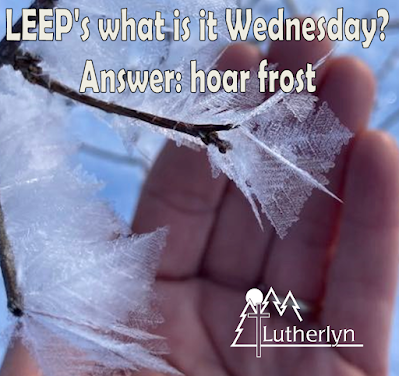
This amazing ice formation is hoar frost. 

Hoar frost forms when water vapor freezes as it comes into contact with a cold surface – water changes directly from the gas stage to the solid stage and forms a crystal. (Snowflakes form the same way, but in the air rather than on a surface.) 

If the air is still and there is enough moisture in the air that water vapor continues to come into contact with the initial frozen crystal, the crystals continue to grow larger. 


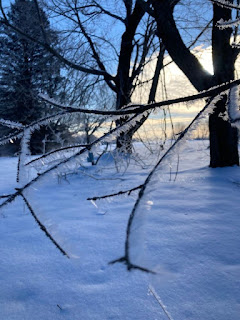
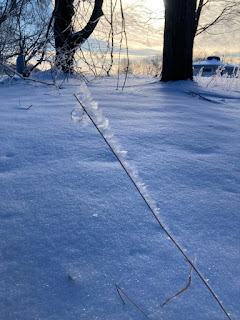
The formation of hoar frost – in particular especially large crystals like the ones seen here – require just the right conditions of moisture, cold, and stillness of air. The largest crystals in these photos were found near the bottom of a large hill, at the base of a short steep slope, and under some overhanging tree branches. Cold air would have settled there overnight (temperatures were in the single digits), been trapped there by the overhanging branches, and been protected from air currents by the tree branches and the slope of the hill. 


“Regular” frost occurs when water vapor in air which is above freezing temperatures freezes onto a surface whose temperature is below-freezing, like the ground or the roof of a building. (This is also a gas to solid change.)

Rime ice occurs when small liquid water droplets freeze on a surface. 
( This is a liquid to solid change.)

Wikipedia tells us that “The word "hoar" comes from an Old English adjective that means "showing signs of old age". In this context, it refers to the frost that makes trees and bushes look like white hair.”


Whether cold and frosty or glowing with the warmth of summer, there’s always a lot going on at Lutherlyn! Go to www.Lutherlyn.com to check out upcoming opportunities to visit Lutherlyn this winter or to register for Summer Camp! 

Like and follow Camp Lutherlyn on Facebook, to see What is it Wednesday posts when they come out and have the opportunity to share your guesses in the comments!

Thursday, January 20, 2022

What is it Wednesday: January 19, 2022


Can you identify what's in this photo?


Each Wednesday morning 

on Camp Lutherlyn's Facebook page

 the Lutherlyn Environmental Education Program posts a photo. 


Readers have all morning and afternoon 

to make their best guess about what the photo is. 


Around 6 pm LEEP provides the answer and a brief explanation.


Each week's What is it Wednesday post 

will also be posted on the Nature of Lutherlyn blog, 

 after it is posted on Facebook,

sometimes with additional bonus information. 


In addition to bringing you current editions of What is it Wednesday 

on the Nature of Lutherlyn blog, 

we will be reposting old editions,

creating a What is it Wednesday archive. 


This photo was posted as a What is it Wednesday on

January 19, 2022. 


And the answer is....


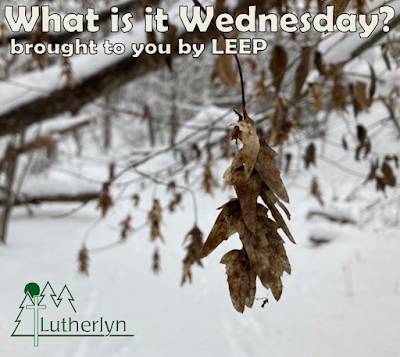
 These are the empty seed capsules of a hop hornbeam tree.

They may look like leaf clusters but they are not. These are the protective sheathing that covered the seeds of the hop hornbeam. The papery sheath has dried up and opened and the seeds have fallen out onto the forest floor, and this is what is left behind. This was the female flower of the hop hornbeam tree.

Hop hornbeam is a small understory tree (about 25-40 feet tall) with soft flaky bark. It is named for its female flowers, which look like the flowers of hop vines used in brewing beer. Like the similar but smooth-barked American hornbeam (also known as musclewood or ironwood) hop hornbeam has strong wood that was often used as tool handles in the past. In fact, both hornbeams are sometimes referred to as ironwood because they both have very strong, dense wood.

Some of the smaller details in the forest are more visible now that we have a thick coating of snow – these seed capsules are a good example, often they are less noticeable against a background of many types of dead leaves. What will you notice if you go out in the forest in the snow? 

Like and follow Camp Lutherlyn on Facebook, to see What is it Wednesday posts when they come out and have the opportunity to share your guesses in the comments!

Thursday, January 13, 2022

What is it Wednesday: January 12, 2022


Can you identify what's in this photo?


Each Wednesday morning 

on Camp Lutherlyn's Facebook page

 the Lutherlyn Environmental Education Program posts a photo. 


Readers have all morning and afternoon 

to make their best guess about what the photo is. 


Around 6 pm LEEP provides the answer and a brief explanation.


Each week's What is it Wednesday post 

will also be posted on the Nature of Lutherlyn blog, 

 after it is posted on Facebook,

sometimes with additional bonus information. 


In addition to bringing you current editions of What is it Wednesday 

on the Nature of Lutherlyn blog, 

we will be reposting old editions,

creating a What is it Wednesday archive. 


This photo was posted as a What is it Wednesday on

January 12, 2022. 


And the answer is....


The marks in this branch (known as a “gallery”) were made by a bark beetle,
probably a European elm bark beetle.

Female bark beetles excavate a narrow groove in the wood just below the bark of a tree, with tiny even-spaced egg niches alternating on either side of the main groove. The female then lays one egg in each niche, and when each larva hatches from the eggs, it eats into the wood away from the mother’s groove and away from each of the other larvae. Each larval track is wider at the end further away from the central groove, because the larvae grow larger as they travel further away from where they started as eggs. The larva pupates at the end of the track, just below the bark, and chews its way out of the tree after it has metamorphosed into an adult beetle.

This gallery was most likely made by European elm bark beetles. Each species of bark beetle creates a distinctive pattern in its galleries. This gallery runs along with the grain of the wood, very closely matches the photos and descriptions of European elm bark beetle galleries, and was found in an area where there are some elm trees.

Keep an eye out for marks like these and you too can see evidence of the hidden lives of insects that are happening all around us! 


Like and follow Camp Lutherlyn on Facebook, to see What is it Wednesday posts when they come out and have the opportunity to share your guesses in the comments!