Monday, October 11, 2021

What is it Wednesday archive: October 24, 2018


Can you identify what's in this photo?


Each Wednesday morning 

on Camp Lutherlyn's Facebook page

 the Lutherlyn Environmental Education Program posts a photo. 


Readers have all morning and afternoon 

to make their best guess about what the photo is. 


Around 6 pm LEEP provides the answer and a brief explanation.


Each week's What is it Wednesday post 

will also be posted on the Nature of Lutherlyn blog, 

 after it is posted on Facebook,

sometimes with additional bonus information. 


In addition to bringing you current editions of What is it Wednesday 

on the Nature of Lutherlyn blog, 

we will be reposting old editions,

creating a What is it Wednesday archive. 


This photo was posted as a What is it Wednesday on

October 24, 2018. 


And the answer is....


This stunning array of leaves didn’t arrive at the base of this tree in this pattern on their own – they were placed there, as part of a nature art project inspired by artist Andy Goldsworthy.  

In 2018 and 2019, students from the Falk Lab School at the University of Pittsburgh spent three days at Lutherlyn, engaging in a wide range of field work in art, math, science, and writing. October, as the leaves at Lutherlyn are beginning to reach their peak of color, seemed like a perfect time to highlight this beautiful display of fall leaves from the past. 

Like and follow Camp Lutherlyn on Facebook, to see What is it Wednesday posts when they come out and have the opportunity to share your guesses in the comments!

Tuesday, October 5, 2021

What is it Wednesday: September 29, 2021


Can you identify what's in this photo?


Each Wednesday morning 

on Camp Lutherlyn's Facebook page

 the Lutherlyn Environmental Education Program posts a photo. 


Readers have all morning and afternoon 

to make their best guess about what the photo is. 


Around 6 pm LEEP provides the answer and a brief explanation.


Each week's What is it Wednesday post 

will also be posted on the Nature of Lutherlyn blog, 

 after it is posted on Facebook,

sometimes with additional bonus information. 


In addition to bringing you current editions of What is it Wednesday 

on the Nature of Lutherlyn blog, 

we will be reposting old editions,

creating a What is it Wednesday archive. 


This photo was posted as a What is it Wednesday on

September 29, 2021. 


And the answer is....


 This is the caterpillar of the imperial moth.

The imperial moth itself was a What is it Wednesday feature about a year ago. It is the largest moth species found in Pennsylvania!


The caterpillar is also one of the largest found in our area. It may be hard to tell from this photo, but this one was about 4 inches long (and caught our attention even as we were driving by on the entrance driveway). Though this one is an olive-green color, they can be found with many different color variations – shades of brown, orange, pink, salmon or green. Regardless of the coloration, imperial moth caterpillars all have white hairs (setae) along the whole body, spiky yellow horns on the front two body segments, and white dots along the sides. The caterpillar will burrow into the ground to pupate over the winter and emerge as adult moth late next summer.

The imperial moth is one of our favorites to see, and it was exciting to find that the caterpillar is just as striking and majestic! 

Like and follow Camp Lutherlyn on Facebook, to see What is it Wednesday posts when they come out and have the opportunity to share your guesses in the comments!


Monday, October 4, 2021

What is it Wednesday: September 22, 2021


Can you identify what's in this photo?


Each Wednesday morning 

on Camp Lutherlyn's Facebook page

 the Lutherlyn Environmental Education Program posts a photo. 


Readers have all morning and afternoon 

to make their best guess about what the photo is. 


Around 6 pm LEEP provides the answer and a brief explanation.


Each week's What is it Wednesday post 

will also be posted on the Nature of Lutherlyn blog, 

 after it is posted on Facebook,

sometimes with additional bonus information. 


In addition to bringing you current editions of What is it Wednesday 

on the Nature of Lutherlyn blog, 

we will be reposting old editions,

creating a What is it Wednesday archive. 


This photo was posted as a What is it Wednesday on

September 22, 2021. 


And the answer is....


This is a giant puffball mushroom. 

This time of year, it’s not uncommon to hear of people thinking they saw a volleyball or soccer ball left sitting in the yard, and on closer inspection realizing it is a large mushroom!

Giant puffballs are solid white on the outside and on the inside when fresh, and have no stem. As puffballs get older, spores develop on the inside, and the previously solid white center becomes a powdery gray-green. When disturbed (stepped on, tapped with a finger, hit with raindrops, etc.), this gray-green powder full of spores puffs out, giving puffballs their name. Giant puffballs are large and usually occur singly in an area, but other types of puffballs are much smaller and occur in large clusters.


puffball mushrooms after decaying and spreading spores

Giant puffballs and their smaller cousins are edible, BUT they do have two very poisonous look-alikes. Here’s a description from www.eattheweeds.com :  “Never take for granted you have a puffball. Always cut each one open vertically, top to bottom, and make sure it is one solid soft white mass inside with no outline.  You should make sure the inside is pure white, never dark, and that the outer skin of the puffball is thin. If the inside is dark from the start and the outer skin is thick you probably have Scleroderma, one of the earth balls. With smaller puffballs you must make sure the entire fruiting body is homogeneous, consistently a texture of marshmallows. You should slice down the center of every puffball to make sure there is not a pre-formed mushroom inside. If so, it is likely to be an immature form of the death angels, Amanita bisporigera, Amanita virosa, and Amanita verna. They are all deadly…. Ninety percent of all mushroom fatalities involve Amanitas.”


a mushroom not fully developed, looking a bit like a puffball but may be an amanita


 Even when you have conclusively identified a puffball, it can only be eaten if the inside is still completely white and a uniform texture.  

Remember to only eat mushrooms if you are experienced in identifying them or are with someone who is; and the safest way to avoid eating a poisonous mushroom is to not eat wild mushrooms. This is much less of a concern for animals, who can often eat many things that are poisonous to humans. The surface of this giant puffball has already been nibbled on by many small creatures – a giant feast!

Fall is a great time to spot interesting mushrooms - keep your eyes open wherever you are outdoors, or check out www.Lutherlyn.com to find out how you can visit Lutherlyn this fall and see what fascinating fungi you can spy here!

Like and follow Camp Lutherlyn on Facebook, to see What is it Wednesday posts when they come out and have the opportunity to share your guesses in the comments!


Thursday, September 16, 2021

What is it Wednesday: September 15, 2021


Can you identify what's in this photo?


Each Wednesday morning 

on Camp Lutherlyn's Facebook page

 the Lutherlyn Environmental Education Program posts a photo. 


Readers have all morning and afternoon 

to make their best guess about what the photo is. 


Around 6 pm LEEP provides the answer and a brief explanation.


Each week's What is it Wednesday post 

will also be posted on the Nature of Lutherlyn blog, 

 after it is posted on Facebook,

sometimes with additional bonus information. 


In addition to bringing you current editions of What is it Wednesday 

on the Nature of Lutherlyn blog, 

we will be reposting old editions,

creating a What is it Wednesday archive. 


This photo was posted as a What is it Wednesday on
September 15, 2021. 


And the answer is....


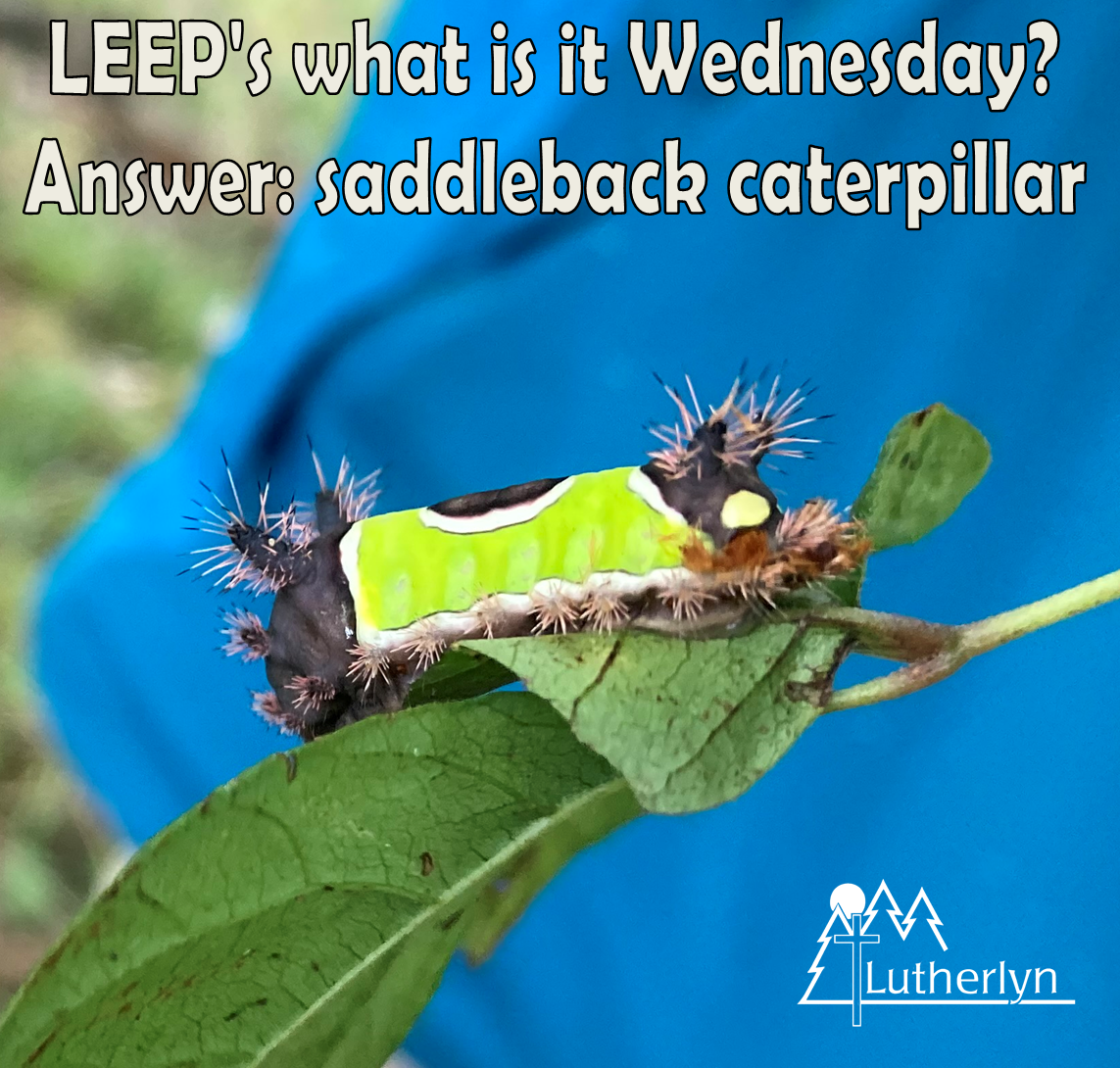
 This is a saddleback caterpillar.
This is one to admire without touching -
saddleback caterpillars have the strongest sting of any caterpillars in Pennsylvania! 

The spiky spines you see around its sides and on the fleshy “horns” on its front and back are filled with venom that causes a sting about as painful as a bee sting. These are called urticating hairs or spines, and the more time the spines are in the skin, the more venom is transmitted. This, or individual sensitivities, can sometimes cause a stronger reaction including nausea and migraines. The bright coloration of the caterpillar is a warning to stay away – this type of warning coloration is called aposematism. As you can see, it also has spots that look like large eyes, which are actually located on the back of its body. Eyespot colorations like this have the effect of startling predators into staying away. The saddleback caterpillar has a full complement of defensive tricks!


The saddleback caterpillar is the larva of a fuzzy dark brown and black moth. It is not common to see saddleback caterpillars at Lutherlyn, but when we do it is late summer/early fall, as that is when they have fully developed. Saddleback caterpillars are also a type of slug caterpillar, which use a layer of liquefied silk to glide instead of walking. (Previous What is it Wednesday feature the monkey slug caterpillar is also a slug caterpillar.) 

It may be hard to tell in the pictures, but this particular saddleback caterpillar was also sitting on a poison ivy leaf – something you don’t want to touch on top of something else you don’t want to touch!

All this may sound intimidating, but saddle back caterpillars are not abundant in our area, and keeping an eye out for their warning colors can help avoid unwanted contact. If you do end up touching one, it will probably be a little painful but will most likely be fairly minor and brief. For more about the ways LEEP can help you learn how to be safe in nature while enjoying nature’s wonders, with school field trips, Saturday Safaris, retreats and more, check out www.Lutherlyn.com/EE.

Like and follow Camp Lutherlyn on Facebook, to see What is it Wednesday posts when they come out and have the opportunity to share your guesses in the comments!

Tuesday, September 14, 2021

What is it Wednesday: September 8, 2021


Can you identify what's in this photo?


Each Wednesday morning 

on Camp Lutherlyn's Facebook page

 the Lutherlyn Environmental Education Program posts a photo. 


Readers have all morning and afternoon 

to make their best guess about what the photo is. 


Around 6 pm LEEP provides the answer and a brief explanation.


Each week's What is it Wednesday post 

will also be posted on the Nature of Lutherlyn blog, 

 after it is posted on Facebook,

sometimes with additional bonus information. 


In addition to bringing you current editions of What is it Wednesday 

on the Nature of Lutherlyn blog, 

we will be reposting old editions,

creating a What is it Wednesday archive. 


This photo was posted as a What is it Wednesday on

September 8, 2021. 


And the answer is....


 These are pokeberries.

The plant they grow on is known as poke, pokeweed, or pokeberry, and can grow up to 12 feet tall each year. The dark purple berries, although attractive, are poisonous to humans. (At LEEP we enjoy teaching people about wild plants that can be eaten, but it is just as important to know which ones you should NOT eat!) The berries are, however, an important food source for many animals, especially birds. The berries can also be used to make dye and ink.

For more on how LEEP can help you learn about the world around us, and for other ways you can visit and experience the nature of Lutherlyn in person, check out www.Lutherlyn.com.

Like and follow Camp Lutherlyn on Facebook, to see What is it Wednesday posts when they come out and have the opportunity to share your guesses in the comments!


Wednesday, September 1, 2021

What is it Wednesday: September 1, 2021


Can you identify what's in this photo?


Each Wednesday morning 

on Camp Lutherlyn's Facebook page

 the Lutherlyn Environmental Education Program posts a photo. 


Readers have all morning and afternoon 

to make their best guess about what the photo is. 


Around 6 pm LEEP provides the answer and a brief explanation.


Each week's What is it Wednesday post 

will also be posted on the Nature of Lutherlyn blog, 

 after it is posted on Facebook,

sometimes with additional bonus information. 


In addition to bringing you current editions of What is it Wednesday 

on the Nature of Lutherlyn blog, 

we will be reposting old editions,

creating a What is it Wednesday archive. 


This photo was posted as a What is it Wednesday on

September 1, 2021. 


And the answer is....


This is honeycomb from one of Lutherlyn’s bee hives. 

The cells we see here are called brood cells – many of them have larva in them. Some of the larva are big and fill the entire cell. Some hatched very recently and are still very small, looking like just a light-colored squiggle at the bottom of the cell. Some of the cells have been capped with wax by the bees in the hive so the larva can begin to pupate, and will soon turn into bees.

Seeing brood cells in a hive is an indicator that there is an active queen present – she has been laying eggs and producing more bees for the hive. The next month or so of late summer is a really important time of year for bees to establish a strong healthy hive and lots of honey going into the winter. We’re so grateful to have honey bee hives at Lutherlyn – thank you to beekeeper Pastor Nathaneil Christman for getting these hives established this summer!

Like and follow Camp Lutherlyn on Facebook, to see What is it Wednesday posts when they come out and have the opportunity to share your guesses in the comments!

Thursday, August 26, 2021

What is it Wednesday: August 25, 2021


Can you identify what's in this photo?


Each Wednesday morning 

on Camp Lutherlyn's Facebook page

 the Lutherlyn Environmental Education Program posts a photo. 


Readers have all morning and afternoon 

to make their best guess about what the photo is. 


Around 6 pm LEEP provides the answer and a brief explanation.


Each week's What is it Wednesday post 

will also be posted on the Nature of Lutherlyn blog, 

 after it is posted on Facebook,

sometimes with additional bonus information. 


In addition to bringing you current editions of What is it Wednesday 

on the Nature of Lutherlyn blog, 

we will be reposting old editions,

creating a What is it Wednesday archive. 


This photo was posted as a What is it Wednesday on

August 25, 2021. 


And the answer is....


These are the flowers of ironweed, a meadow wildflower that grows up to 8 feet tall.

The name refers to the toughness of its stem, and it is a member of the aster family. Butterflies, bees, and other pollinators love it. Their intense purple color is striking, and looks especially pretty in a field mixed with goldenrod, which also blooms in late summer.

Author Robin Wall Kimmerer, a botanist and a member of the Citizen Potawatomi Nation, has a beautiful and insightful reflection on the connection between asters and goldenrod, purple and yellow, in her book Braiding Sweetgrass: Indigenous Wisdom, Scientific Knowledge and the Teachings of Plants. She points out that purple and yellow are reciprocal colors, perceived by the same receptors in the eye. This is true for both the eyes of humans and the eyes of bees. 

"This doesn’t explain why I perceive them as beautiful, but it does explain why that combination gets my undivided attention. I asked my artist friends about the power of purple and gold, and they sent me right to the color wheel: these two are complementary colors, as different in nature as could be. In composing a palette, putting them together makes each more vivid; just a touch of one will bring out the other. Purple and yellow are a reciprocal pair.


"The real beholder whose eye they hope to catch is a bee bent on pollination. As it turns out, golden rod and asters appear very similarly to bee eyes and human eyes. Their striking contrast when they grow together makes them the most attractive target in the whole meadow. Growing together, both receive more pollinator visits than they would if they were growing alone."


"It’s a testable hypothesis; it’s a question of science, a question of art, and a question of beauty. Why are they beautiful together? It is a phenomenon simultaneously material and spiritual, for which we need all wavelengths of knowledge.

… its wisdom is that the beauty of one is illuminated by the radiance of the other. Science and art, matter and spirit, indigenous knowledge and Western science— can they be goldenrod and asters for each other?"


For a full excerpt of the essay, go to https://commons.bluemountaincenter.org/goldenrod-and-asters-my-life-with-plants/ . 

And for more on how you can visit Lutherlyn to engage both the material and the spiritual, visit www.Lutherlyn.com . 


Like and follow Camp Lutherlyn on Facebook, to see What is it Wednesday posts when they come out and have the opportunity to share your guesses in the comments!