Monday, May 20, 2013

Go Outside!

     I hear my mother's voice echo in my head as I tell my own children to "go outside!"  When I was growing up, I think these words were heard in most households.  Unfortunately, my children are probably in the minority for hearing those words now.
     In general, parents have a greater fear of the outdoors than in the past.  The media has made child abductions seem common place and outdoor accidents often make overblown news stories.  Plus, we are another generation or two removed form agriculturally life and connection to the outdoors.
     The good news is that these dangers are only perceived.  The risk of child abduction is no greater now than it was in the 1970s or 1980s.  What is the greatest cause of childhood fatalities?  Riding in automobiles.  Are people going to stop driving their kids around?  Children probably spend more time in cars now than ever before.  What causes the most accidents at home?  Falling down stairs.  So, obviously it is in our children's best interest to get them outside - AWAY from those dangerous stairs!
     Playing outdoors allows children to be adventurous, to practice the scientific method, to learn hands-on about living things.  In a more philosophical and theological sense, time spent outside, allows children to connect to nature and God's creation.  They can see it as an integral part of who we are as humans.  they have a greater understanding of how we fit as part of creation.  The more we see ourselves as part of this planet, the better we will care for the other parts of the planet - and that can only make this a better and safer place to live.

Tuesday, May 14, 2013

Spring's Arrival II

      April 7th was the second really warm day of spring.  In some parts of western PA it came with the first rain of spring.  As I drove down the dark back roads heading to Gettysburg, I kept my eyes alert for small amphibians.  Sure enough, I had to make a last minute adjustment to avoid a toad hopping across the mountain road at about 9:30 pm.
 
Red-spotted Newt returning to Lower Lake

     The first warm spring rains bring one of the most amazing animal events that few people know about - the spring amphibian migration.  The warmth and rain convince the amphibians it is time to mate and lay eggs.  Frogs, toads, and salamanders have been hibernating all winter.  Most of them have hibernated below ground, but the tree frogs have stayed above ground.

     This is because treefrogs have a special adaptation for surviving winter.  When the temperatures start to get cold, the frog's body produces glucose that undergoes a complicated process with adrenaline to prepare the cells in the frog for cold storage .  This natural anti-freeze protects the frog's body when temperatures drop below freezing.  Occasionally, people find tree frogs in the winter and they appear to be frozen solid.  If brought indoors, they will start to hop around after they warm up.  (However, this is probably not good for the frog - especially if its going back outside.)
     Once the temperatures warm the tree frogs, and other amphibians, start moving to wet areas to reproduce.  They tend to do this at night during a warm rain.  The rain is needed to keep the amphibian's skin moist as humidity levels this time of year can be very low.
Lower Lake filling
      Amphibians migrate to ponds, lakes, wetlands, and vernal pools.  The latter are small ponds that dry up in the summer - so they don't have the aquatic predators that ponds and lakes have.
     At  Lutherlyn, spring peepers and American toads congregate at the lower lake.  This lake is drained each winter to reduce plant growth and keep it safe from swimming.  As a result, there aren't any fish looking for a frog, toad, or tadpole snack.  Schools that visit on overnight field trips get to experience the frogs and toads congregating at Lower Lake.  By May 15th, the shallows of the lake are usually filled with small tadpoles.
      The tadpoles grow fast and usually are leaving the lake by the first week of summer camp (the third week of June).  The first weeks of summer camp mark the secondary amphibian migration as very tiny frogs and toads leave the water and disperse throughout Lutherlyn.

Friday, April 19, 2013

Spring's Arrival I


     Most people see the change from winter to spring in the warming temperature and the blooming daffodils.  Out in the forest, and here at Lutherlyn, the change is amazing!
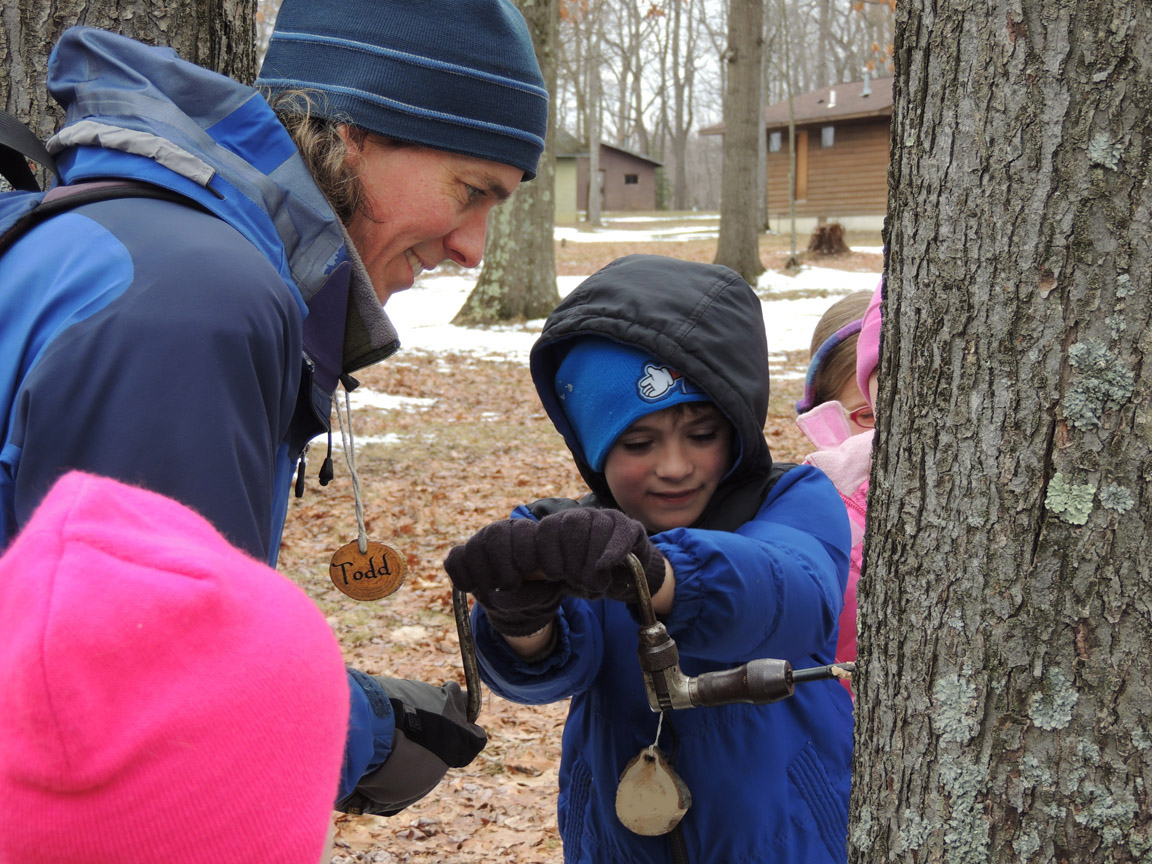
     With cold temperatures lasting two weeks longer than last year, we had two additional weeks to make maple syrup.  That was a blessing as we only had a few gallons of syrup made by March 15.  The cold temperatures had made syrup production pretty slow.  (For maple sap to flow, temperatures inside the tree have to rise above 40 degrees Fahrenheit and fall back below freezing each day.)  Although we had many days above freezing, it didn't get much above freezing.


     By the end of the season, we had about 100 buckets that students had hung on the maple trees.  The warm temperatures on March 10 and March 30 produced about 2 gallons of sap per tree - giving us about 200 gallons of sap to boil down after each one of those runs.  With that much sap, the challenge is to boil down the sap fast enough to keep it from fermenting with the warmer temperatures.  We were blessed with cooler temperatures after those good runs which "refrigerated" the sap and our sugar maker, Gordie, did a great job boiling the sap very quickly.


     The last boiling halted on Thursday, April 4, with the grand total reaching 10.5 gallons of Lutherlyn's pure maple syrup being produced.  All that is left  is the clean-up:  putting away buckets, lids, & spiles, and cleaning tubing and tanks.  The biggest job is scrubbing the evaporator.  The minerals in the sap are cooked out as the sap boils and they become stuck to the stainless steel pans.  removing these deposits requires hot water, a weak food -grade acid, and hours and hours of elbow grease.  It is the toughest part of maple sugaring, by far.  Thankfully, we have 10.5 gallons of syrup to make all of the work worthwhile.
     If you want to help us enjoy the syrup, join us on May 5th for Camp BLAST!  We will be serving free pancakes and maple syrup from noon until 3:30 pm.  The day will also include plenty of other free activities including nature hikes, hay rides, pony rides, games, rocket launches, climbing, zip-lining, canoeing, crafts, archery, and archaeology.  Mark your calendars, you won't want to miss this!

Camp Blast Post Top

Thursday, February 7, 2013

Ashes to Ashes

     With the leaves down, trees like the one at the left, stand out in the forest.  You can pick them out, even while driving down the road.  Have you seen them?  These are trees that have a very light brown bark.  Actually they are loosing their bark - woodpeckers are rapidly chiseling it off.  These trees are dead, or nearly so. Don't blame the woodpeckers; the tree was already 'mostly dead' and they are just looking for food.  This tree's demise is the result of yet another invasive species from Asia - the emerald ash borer.


     Emerald ash borers are small metallic green beetles that appeared near Detroit in 2002.  In the last twelve years, they have infested 18 states and are voraciously devouring our native ash trees.  Emerald ash borers are about 1/2" long and can fit on a penny.
Emerald ash borer exit hole
     A female emerald ash borer lays about 100 eggs on the bark of ash trees.  The larvae hatch and eat through the outer bark.  It is the larvae of the borers that do the real damage.  They eat the inner bark and new sap wood of the ash tree.  The adult beetles emerge from 'D-shaped' exit holes about a year later. Within four years of the initial egg laying, the tree is dead.  So far these insects have killed 100 million trees and there isn't much to slow them down.
     Currently scientist are experimenting with several pesticides that are injected into ash trees or applied to the soil around the trees.  There has been some limited success, but they must be applied every 1 to 2 years and consistent treatment will probably harm the tree.
     Some scientists have experimented with releasing parasitic wasps that control the borers in Asia.  The obvious problem here is introducing another alien insect to deal with the one that we already have. Hopefully, these methods, plus the possibility that some individual ash trees my be naturally resistant to the borer, will enable at least a few trees to survive.
     Ash trees have some of the toughest wood of any North American tree.  For centuries this wood has been used for snowshoes, canoe paddles, sleds, wagons, skis, tool handles, hockey sticks, and (of course) baseball bats.  In fact, the famous Louisville Sluggers, used my most major league baseball players, come from white ash trees in northern Pennsylvania and southern New York. 
     Unfortunately, the future of these trees is very much in doubt.  Many believe that we are witnessing the same devastation that past generations saw with the American Chestnut blight (see my previous post: http://lutherlynnature.blogspot.com/2012/12/100-american-chestnuts.html).  The future of the North American ash species will probably lie in programs many years down the road.  We will have to rely on future generations to bring back our ash trees.
      There is something you can do, though, to at least slow the spread of the infestation:  Don't transport firewood.  The adult borers often hide in firewood and transporting it can cause the devastation to spread.  For more information, please see the USDA website:  http://stopthebeetle.info/
      Also, please don't take out your frustration on another emerald colored beetle.  The six-spotted tiger beetle is one of my personal favorites.  It is a great predator and eats lots of small insects and spiders.

Six-spotted Tiger Beetle


Tuesday, January 29, 2013

Winter De-Fence

     This time of year many of us are receiving garden seed catalogs in the mail.  It can be fun to page through them and imagine what great vegetables we could grow this coming summer.  Personally, I find greater enjoyment paging through the tree catalogs that also arrive this time of year.  I like to imagine the mature trees that could one day shade large areas or produce large quantities of fruit.  I have planted my share of fruit and shade trees; however, the most successful trees that I have planted have been windbreaks.
     Windbreaks are plants (or structures) that protect homes, driveways, and planted areas from the wind.  They are common around many old homesteads.  The use of windbreaks was once common knowledge, but now, it seems to be, well, uncommon. 
      It is suggested in some publications that well-placed windbreaks can save a homeowner nearly 50 percent on heating and cooling bills.  Even a savings of 20 percent, makes a windbreak a major component of an energy conservation strategy.  Most of us can relate to wind chill.  As the wind speed increases, the air feels colder - and so do we.  Reducing the wind velocity around a home reduces the chill factor and lowers home heating costs.
     In the late 1990s, I planted a variety of evergreen trees behind the house at Terra Dei Homestead, here at Lutherlyn.  Some were small pine and spruce seedlings that I transplanted from the forest nearby.  A few were trees that were given away by the Butler Garden Club for Arbor Day.  None were taller than 18 inches.  However, fifteen years later these trees are taller than the house at Terra Dei and they are doing a great job of blocking the northern winds.
Terra Dei's 15-year old windbreak
     Windbreaks also provide cover for wildlife.  Many birds select evergreen trees as shelter in the winter.  It is difficult keeping those little bodies fueled all winter long, so any way of reducing the chill of the wind increases their ability to survive.
      In 2006, my wife and I (along with our church's youth group) planted 200 white and red pine trees along our driveway.  The trees were two years old when we planted them and about twelve inches tall.  Coming up on seven years, most of the trees are over 10 feet tall and have formed a substantial barrier to the wind.  Six years ago, we could count on our driveway drifting shut when there was snow on the ground.  Now, we have very little drifting and a beautiful row of evergreens.
    As you are looking at those seed and tree catalogs that are arriving in the mail, stop to consider energy conservation, as well as food production.  For a very small investment of time and energy, you can end up with substantial energy savings down the road.  There is nothing like a strong "de-fence" against the winter winds.
    For more information about Terra Dei Homestead, please visit LEEP's website:  www.lutherlyn.com/EE and follow the link to Terra Dei Homestead.

Thursday, December 13, 2012

Successional Forests

    Our forests are one of Lutherlyn's most important resources.  The Lutherlyn Environmental Education Program would certainly be much different if we didn't have such a great forest resource.  Lutherlyn contains somewhere in neighborhood of 300 acres of forest and, as you hike the trails, it feels like that forest has been here for centuries.  For the most part, that is not actually the case.
     Three hundred years ago, the area that would become Lutherlyn, like most of Pennsylvania, was almost entirely forested.  Much of Pennsylvania was covered in White Pine and Eastern Hemlock forests, although there were also plenty of oak and chestnut trees, too.  By 1920, the lumber industry had finished devastating Pennsylvania and moved on to other states.  In the last 100 years, much of this land has returned to forest through a process called succession.
     Succession is a natural ecological process whereby disturbed areas naturally return to climax communities.  In our region, the climax community is a forest ecosystem, but oaks and hemlocks do not spring up from large areas of bare ground.  Succession is a process.
Chapel Hill from Main Camp ~ 1952
     One area at Lutherlyn particularly intrigues me when thinking about succession.  The forest between main camp and Terra Dei Homestead has changed a great deal over the past 60 years.  Here is a picture taken from main camp shortly after Chapel Hill was constructed; its probably from the summer of 1952.  Notice that there are very few trees between the craft cabin and Chapel Hill.  If the camp staff had stopped mowing that area, small trees would have moved in within 3 years, but they would have been hawthorns, crab apples, sumac, and locust - not what most people at that time considered "good" trees.
    Evidently, though, a forest was desired because the picture below, from 1954, shows that rows and rows of Scots Pines have been planted in the area.  Pines were planted in many camps at that time.  They were fast growing, so it didn't take long to get a forest and they could be thinned periodically and used to build cabins or sold for lumber.  This area was never thinned, however, and the Scots Pines have continued to grow for the last sixty years. 

      Sixty years ends up being the natural life expectancy of most Scots Pines, but during the last six decades those pines have sheltered many young trees that have grown up to take their place.  So this process of succession continues with Red Maple trees now taking over the forest that was planted to be pines.  Some Norway Spruce trees have also made their way into this forest from those planted nearby.  The picture below was taken early this fall.  Notice the Scots Pines falling over, while the Red Maples and Norway Spruce rise up to take their place.
     This forest is not done changing.  The process of succession is on-going.  As the maples mature, they will shelter oaks and hickories that could become the climax forest community.  Alternatively,  in a hundred years or so, these trees could be out-competed by White Pines and Eastern Hemlocks, but there aren't many of those close by to provide seed for that future forest.  If we are looking 100 years down the road, we also have to wonder what our forests will look like once our climate has warmed.  Whether Lutherlyn's forest is going to reach a climax community may have more to do with what you and I do as stewards of this planet than what trees start to grow.

Thursday, December 6, 2012

100% American Chestnuts!

    The American Chestnut tree is now a thing of legend.  At one time, it is said, the tree made up nearly 1/3 of the Appalachian forest.  Some chestnut trees were said to live 500 to 600 years, grow 100 feet tall and up to 8 feet in diameter!  That is a legendary tree.
     The American Chestnut tree also provided food for humans and animals in the form of nuts; they were a favorite food of the (now extinct) passenger pigeon.  Many nuts were sold to provide income to sustain families.  The wood of the chestnut was used for constructing homes, furniture, tool handles, and fence posts.
     The whole chestnut "economy" came crashing down a hundred years ago.  In the 1880s, some folks brought Japanese and Chinese chestnuts to the United States in the hopes of creating hybrids with the American Chestnut.  Unfortunately, they also brought a fungus along, too.  The asian chestnuts had a resistance to the blight caused by the fungus, but not the American Chestnut.  In 1904, the blight was discovered on a tree in the Bronx Zoo and by 1908 it was in Pennsylvania.  By 1930 nearly all of Pennsylvania's chestnuts had the blight and by 1950 the American Chestnut was gone.  Still today, old stumps may still produce some growth, but it soon succombs to the blight, too.
American Chestnut leaves
     This is the point where the complex genetic code of organisms allows for light at the end of the dark tunnel.  Genetic variation in individuals provides a possibility that a few individuals may be resistant to a disease that harms the rest of a population.  It is also possible to breed individuals to possess this resistance.  Currently, there are two different strategies for bringing back the American Chestnut.
     The American Chestnut Foundation has crossed the American Chestnut with the Chinese Chestnut and then back-crossed all of the descendents for 5 generations to end up with a tree that is 99% American Chestnut and 1% Chinese Chestnut.
     The American Chestnut Cooperators' Foundation searched out American Chestnut survivors and has been breeding them for 40 years.  These are 100% American Chestnuts and are descendents of trees that have natural resistance to the blight.  These trees are not immune to the blight, but a majority of their offspring can survive with the blight.  The ACCF works in conjunction with the public and distributes chestnut seeds to be planted throughout the region.
Lutherlyn's American Chestnuts
     At Lutherlyn, we planted two crops of chestnut seeds from ACCF, one in 1999 and another in 2001.  From those crops, we currently have 11 flourishing American Chestnut trees at Terra Dei Homestead.  Two of these trees are over 20 feet tall and over 4 inches in diameter.  This year, for the first time, three of the trees produced nuts!
     It is extremely gratifying to see these chestnuts reproducing.  It allows us to imagine a day when American Chestnuts will again become part of our forest ecosystems.  The American Chestnut's return means that the tree that the Iroquois once used to build longhouses and settlers once used to build log cabins and split rail fences will again be a part of our forest.  It will once again support wildlife and people and may, one day, regain its legendary place in Appalachia.

    For more information on these two organizations, please click on the links below.
         American Chestnut Cooperators' Foundation
              American Chestnut Foundation